
Bellringing is a historic, challenging, and above all fun activity for people of all ages, backgrounds, and skill levels.
Our Teaching Hub exists to give you the best introduction to this, your new favourite hobby! We start you off with the foundations of solo bell handling, before progressing to ringing rounds, changes, and methods with other people.
If you’re interested in giving it a go, contact us to arrange a taster session at one of our towers – or, for more information, read on.
How it works
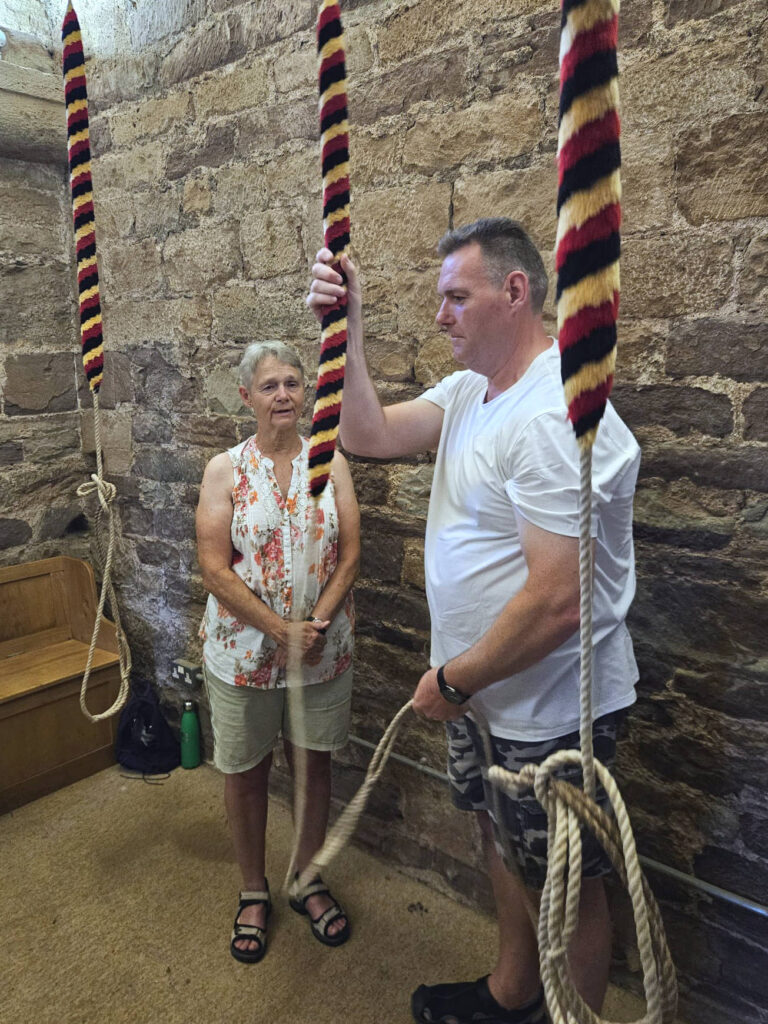
Whether you’re from one of our home tower locations, or further afield, arrange a free taster session with one of our accredited teachers and find out more about what’s involved.
What to expect in your taster session:
- A Tour of the bells (if possible)
- Health & Safety brief
- Hands-on training
What’s next?
If you want to continue your bellringing journey, you can arrange 4–8 weeks of focused practice with our accredited teachers. These practices are aimed at building the foundational skills needed to ring a bell unaided by following the Learning The Ropes curriculum. You will receive all this and an LTR training logbook, which you will complete with your teacher at each practice.
Is it free?
In an ideal world, we would deliver all of our courses and sessions for free. Our teachers are all volunteers and don’t get paid – but we still need to cover the costs of training materials, contribute towards the maintenance of the bells and towers we use and the running costs of the Hub. For this reason, we ask for a donation from our learners. You’ll find out more about this at your free taster session.
What you’ll learn
Our primary goal is to get learners to a level of skill and confidence that they can safely ring a bell on their own. In the bellringing world, this is called “bell handling”, and it involves:
- Recognising parts of the bell and rope, and understanding how they work
- Ringing the bell on a handstroke
- Ringing the bell on a backstroke
- Ringing both strokes together
- Ringing the bell up (getting it ready to ring) and ringing the bell down (when you’re finished ringing)
- Standing the bell, on handstroke and backstroke
- Varying the bell’s speed
- Ringing rounds with other people
When you have successfully demonstrated these skills, you will be awarded an ART Learning The Ropes Level 1 certificate.
At this point, you’re effectively skilled enough to start ringing with your local tower, or any other band for that matter. But your learning journey has only just started!
At the Burghill Teaching Hub we also support our member towers to continue developing the skills of their learners – from ringing rounds, to call changes, to methods – progressing through further levels of the Learning The Ropes programme.
So, even after you’ve learned the basic skills at our foundational training sessions, we’d strongly encourage you to keep joining us at future sessions, where we can help you continue to learn and hone your skills.
Accessibility
One of our core goals is to make bellringing as accessible as possible to as many people as possible.
Despite what people may think, bellringing does not require significant upper body strength. A learner with proper technique can ring one of our smaller bells with very little effort.
Age and height are also not barriers. We have a number of young learners, and learners of all shapes and sizes, and through the use of boxes (to raise a ringer up off the floor) and/or knots (to shorten a rope) we’re able to accommodate pretty much everybody.
You will, however, need to be able to raise your arms above your head. And you will also need enough dexterity to grip and release the rope and sally, in time with the bell’s motion.
To reach the ringing chambers in our current towers, you will need to climb either a spiral staircase or a ladder, and some also require you to duck under low doorways or step over short obstacles. This means that, sadly, none of our current towers are wheelchair accessible. But it absolutely is possible to ring from a wheelchair – so if you’re keen to learn, get in touch, and we’ll see whether we can arrange some sessions for you at one of the handful of ground-floor ringing chambers in the wider Herefordshire area.
We’re also happy to adapt our teaching practices to assist learners with learning difficulties, dyslexia, dyspraxia, and autism. Every learner is different, and there are lots of ways we can help you get the most out of ringing. The best way to find out whether bellringing is something for you, is to contact us and arrange a taster session!